

Opening My Heart Meant Admitting What My Heart Could Never Accept


For a long time, people kept telling me the same thing.
"Open your heart."
And every time I heard those words, I asked myself the same question:
What exactly am I supposed to do?
Love more?
Become softer?
Be more patient?
Accept more?
I genuinely didn't understand.
I thought my heart was already open. I loved. I empathized. I tried to understand another person. I searched for answers in psychology, spirituality, and endless self-reflection.
Yet something still felt unresolved.
Eventually, I realized that opening my heart had nothing to do with loving someone else more.
It had everything to do with finally telling myself the truth.
A truth I had avoided for a very long time because I was afraid it would make me seem "less spiritual."
I was ashamed.
Not because I loved someone.
But because other people could have looked at my situation and assumed I was willing to be someone's option.
The truth is...
I never was.
Those are two completely different things.
For years, I kept saying,
"I don't understand what it means to open my heart."
I assumed it meant becoming even more loving.
But my boundaries and my self-worth were stronger than my feelings, and that created an inner conflict I couldn't explain.
Eventually I realized that opening my heart wasn't about loving harder.
It wasn't about becoming softer.
It wasn't about finding more compassion for another person.
It was about finally stopping myself from hiding what had actually been hurting me all along.
One part of me kept saying,
"I'm on a spiritual journey. I should be understanding. I should be loving."
But another part quietly whispered,
"This situation goes against everything I believe in. It hurts me to even imagine myself in it."
As long as that second voice remained unheard, the conflict never disappeared.
Today I understand something I couldn't see back then.
That kind of relationship simply doesn't align with my values.
If I had the boundaries I have today, I wouldn't have agreed to participate in that dynamic at all.
Ironically, that realization became the very thing people had been telling me to do all along.
Open my heart.
Not by removing my boundaries.
Not by becoming more patient.
Not by finding more excuses for someone else's choices.
But by honestly admitting to myself:
"I kept pretending I was okay."
"But I wasn't."
"It hurt."
"I was ashamed to find myself in a situation that contradicted who I know myself to be."
"And I no longer want to live against my own values."
One of the biggest lessons I learned is that spirituality does not require us to stay in relationships that violate our values.
But this isn't something we understand intellectually.
It's something we have to allow ourselves to feel.
Sometimes that emotional honesty becomes the exact turning point that finally brings peace.
When I admitted the truth, something unexpected happened.
The shame stopped hiding.
Shame has an interesting characteristic.
It lives in the shadows.
As long as we cannot honestly admit what we're ashamed of, it quietly continues shaping our lives.
But once we acknowledge it without judging ourselves, it begins to lose its power.
That's exactly what happened to me.
I wasn't ashamed of myself.
I was ashamed that I had found myself in a situation that completely contradicted my values.
Yet I kept telling myself I didn't care.
Looking back, I think that's one of the most important distinctions we can make.
There is a difference between being ashamed of yourself...
and feeling ashamed of a situation.
The first says,
"There is something wrong with me."
The second says,
"This situation wasn't right for me."
One destroys self-worth.
The other protects it.
Especially if you've done everything you could with honesty.
If you've communicated clearly.
If you've established your boundaries.
If you've acted with integrity.
You don't need to be ashamed of yourself.
It's perfectly human to feel ashamed of finding yourself in a situation that never reflected your values—especially if you entered it without knowing the whole truth.
From a Jungian perspective, the Shadow isn't only made of our "dark" qualities.
The Shadow is everything we refuse to acknowledge because it doesn't fit the image we have of ourselves.
In my case, the Shadow wasn't the relationship itself.
The Shadow was admitting:
"I'm ashamed that I found myself in a relationship that contradicts my own values."
Why was that so difficult?
Because it meant letting go of one of the most common narratives within the twin flame community:
"If this is your twin flame, you should wait."
"You should understand."
"You should trust the process."
If part of me believed that a "good" Divine Feminine always accepts, always understands, and always waits...
Then shame simply didn't fit that identity.
It felt easier to explain everything through spiritual concepts than to admit something much simpler.
"No."
"It felt humiliating to be in that position."
Admitting that doesn't make us less spiritual.
It makes us more honest.
And honesty creates clarity.
I've also realized something else.
Shame often protects something deeply valuable.
If I felt ashamed, it wasn't because something was wrong with me.
It was because mutual respect mattered to me.
Integrity mattered to me.
Dignity mattered to me.
Equal partnership mattered to me.
Behind my shame wasn't my weakness.
It was my moral compass.
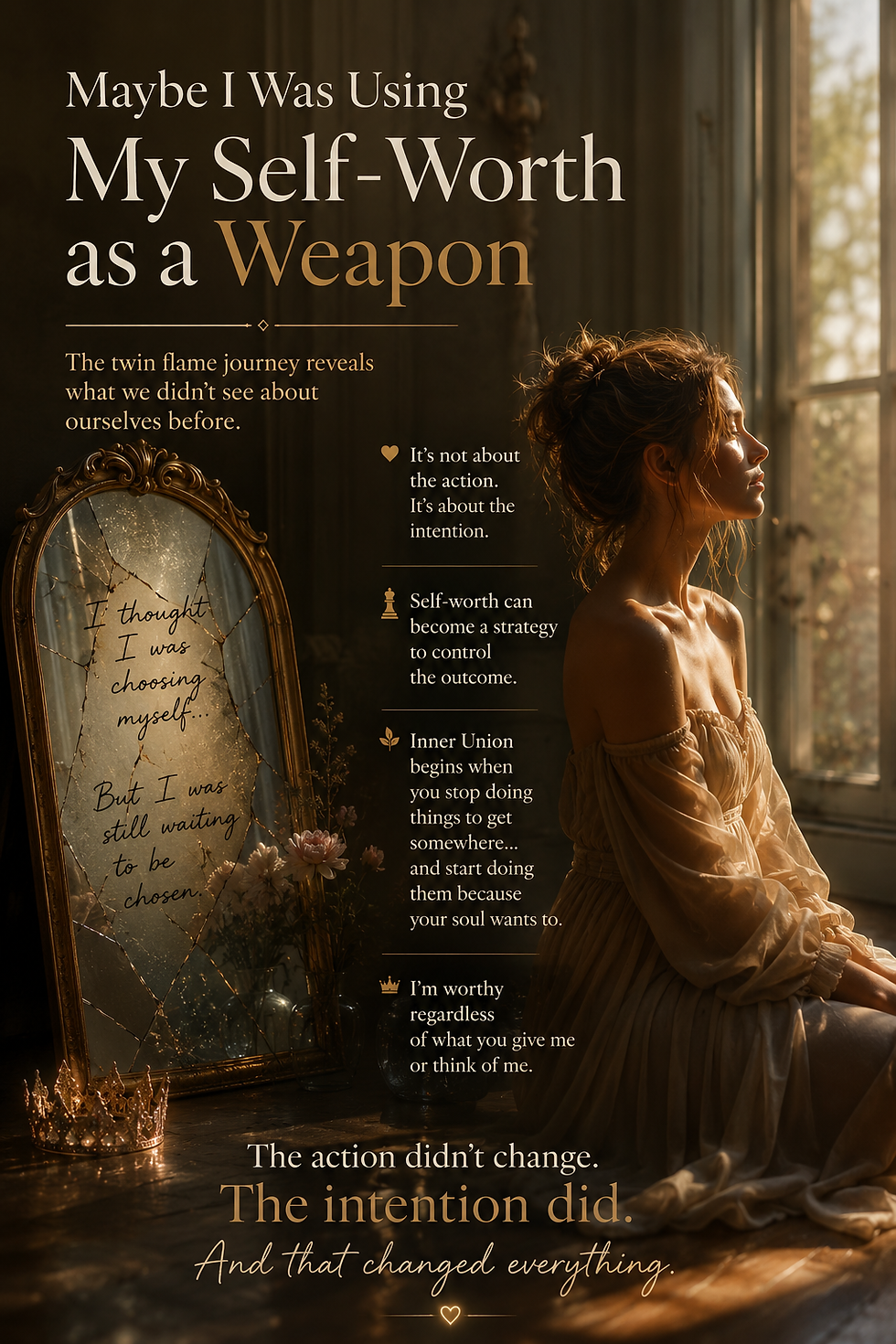
Perhaps what finally became integrated wasn't the shame itself.
It was the part of me that could finally say:
**"I have every right to refuse relationships that go against my values."**
Maybe that's why people often feel relief after acknowledging their Shadow.
The Shadow stops being something we have to hide.
Carl Jung wrote that becoming conscious of the Shadow doesn't mean believing you're a bad person.
It means becoming aware of feelings that have always existed instead of pretending they don't.
The moment those feelings are no longer forbidden...
they stop controlling us from the background.
I've also realized something else.
When people tell us to "open our hearts," they don't always mean becoming kinder to other people.
Sometimes it means finally stopping ourselves from shutting down our own emotions.
Stopping ourselves from pretending we're not hurt.
Pretending we're not ashamed.
Pretending we're not afraid.
Pretending everything is fine when, deep inside, we know it isn't.
Perhaps that is what true honesty with ourselves really looks like.
And perhaps that is what Inner Union became for me.
Not because another person changed.
But because I finally stopped arguing with my own heart.
Sometimes opening your heart doesn't mean letting someone back into your life.
Sometimes opening your heart means finally admitting what your heart could never truly accept.
I decided to share my personal experience because I know how long, confusing, and exhausting inner work can sometimes feel.
If my story helps even one person understand themselves a little better, then sharing it was worth it.
yourrrr_soul
Author of Under My Skin
Twin Flames | Healing | Inner Union | Self-Worth
Instagram: @yourrrr_soul
Only official account: @yourrrr_soul


Комментарии